Introduction
Engineers often struggle to identify the root cause of failures in distributed systems, but the Master in Observability Engineering (MOE) changes that dynamic entirely. Professionals who master these skills stop guessing and start analyzing real-time data to maintain system health. DevOpsSchool provides this specialized training to help you navigate the complexities of microservices and cloud-native architectures. This guide explains how you can transition from simple monitoring to deep system introspection.
Leaders in the tech industry now prioritize observability as a core engineering discipline rather than an afterthought. By following this roadmap, you will learn to build resilient telemetry pipelines that provide actionable insights during critical outages. We designed this resource to help SREs, developers, and managers understand the certification landscape and choose the most effective learning path for their specific career goals. Mastering these concepts ensures that you remain an essential asset in any high-stakes production environment.
What is the Master in Observability Engineering (MOE)?
The Master in Observability Engineering (MOE) represents a rigorous professional standard for engineers who build and manage modern telemetry systems. It focuses on the technical ability to extract meaningful information from complex, distributed software environments through logs, metrics, and traces. Unlike basic monitoring courses, this program teaches you how to design systems that are inherently “observable” from the inside out. You learn to implement standards like OpenTelemetry to ensure your data remains portable and vendor-neutral across different cloud providers.
Enterprises demand this level of expertise because traditional tools fail to keep up with the scale of modern Kubernetes clusters and serverless functions. The MOE program emphasizes a production-first mindset, where you solve real-world problems using high-cardinality data and distributed tracing. It aligns perfectly with the needs of global tech companies that require 99.99% uptime and rapid incident response. By completing this program, you demonstrate that you can handle the architectural challenges of the modern cloud-native stack.
Who Should Pursue Master in Observability Engineering (MOE)?
Site Reliability Engineers (SREs) and DevOps professionals find the most immediate value in this certification because it directly impacts their daily operational efficiency. Platform engineers who build the internal tools for developer teams also benefit significantly by learning how to provide “observability-as-a-service.” Even software developers should pursue this track to understand how their code behaves in live environments. When developers know how to instrument their applications correctly, they reduce the time spent on debugging and increase their deployment confidence.
Cloud architects and security analysts in India and across the globe also see this as a vital career move. Security teams use observability data to hunt for threats and detect anomalies that traditional firewalls might miss. Engineering managers and technical leads should pursue the foundational tracks to better lead their teams through digital transformations. Whether you are a veteran system administrator or a fresh engineering graduate, this certification provides the specialized knowledge needed to thrive in high-scale enterprise environments.
Why Master in Observability Engineering (MOE) is Valuable
Mastering observability engineering provides a massive competitive advantage because it solves the “black box” problem of modern software. Companies lose millions of dollars during downtime, and experts who can shrink the Mean Time to Resolution (MTTR) command the highest salaries in the market. This certification proves that you can manage the sheer volume of data generated by thousands of microservices without getting overwhelmed. It shifts your role from a reactive firefighter to a proactive system architect who ensures reliability through data-driven decisions.
The longevity of this skill set makes it a wise investment for any tech professional. While specific monitoring tools come and go, the principles of telemetry, data correlation, and system introspection remain constant. By focusing on these core engineering truths, you protect your career against the rapid shifts in the technology landscape. Furthermore, the global shift toward AIOps and automated remediation requires a foundation in high-quality observability data, making this certification the first step toward the future of autonomous operations.
Master in Observability Engineering (MOE) Certification Overview
DevOpsSchool delivers the Master in Observability Engineering (MOE) program through a specialized curriculum hosted on their enterprise learning platform. The certification follows a structured approach that tests both your theoretical knowledge and your ability to execute technical tasks in live lab environments. You will work with a variety of open-source projects and industry-standard tools to build a comprehensive understanding of the entire observability lifecycle. The program focuses on practical outcomes, ensuring that every certified professional can immediately contribute to a production team.
Students progress through different tiers of certification, each focusing on a specific level of technical depth and organizational responsibility. The assessment process includes rigorous practical exams that require you to troubleshoot real-world scenarios and optimize telemetry pipelines. This ownership-driven model ensures that the MOE credential carries significant weight during the hiring process. By the end of the program, you will possess a portfolio of work that demonstrates your ability to design, implement, and scale observability solutions for any enterprise environment.
Master in Observability Engineering (MOE) Certification Tracks & Levels
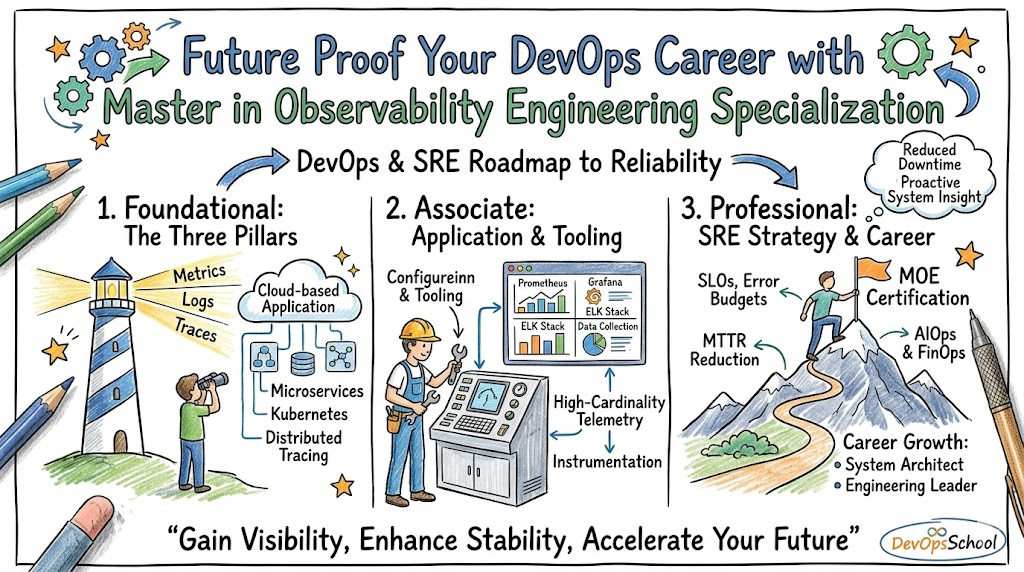
The certification program offers three primary levels to accommodate engineers at different stages of their professional journey. The Foundational level serves as an entry point, where you master the vocabulary of observability and the basic mechanics of data collection. It provides the essential context needed for any role in modern IT operations. As you move to the Associate level, the focus shifts toward the implementation and management of specific tools like Prometheus, Grafana, and the ELK stack.
The Professional and Specialty levels represent the pinnacle of the MOE program, focusing on high-level architecture and strategic SRE practices. At these stages, you learn to manage “observability at scale,” dealing with petabytes of telemetry data and complex service meshes. Specialization tracks allow you to align your certification with specific domains like FinOps, SecOps, or AIOps. This tiered structure ensures that you can continuously grow your skills and earn higher-level credentials as your career progresses and your responsibilities increase.
Complete Master in Observability Engineering (MOE) Certification Table
| Track | Level | Who it’s for | Prerequisites | Skills Covered | Recommended Order |
| Core Fundamentals | Foundational | Beginners / Managers | General IT Knowledge | Pillars of Telemetry | 1st |
| Operations | Associate | DevOps / SysAdmins | Foundational Level | Tool Implementation | 2nd |
| SRE Excellence | Professional | Senior SREs | Associate Level | SLOs & Error Budgets | 3rd |
| Architecture | Specialty | Platform Architects | Associate Level | System Design | 4th |
| Intelligent Ops | Advanced | Data Engineers | Professional Level | AIOps & ML Integration | 5th |
| Cloud Economy | Specialty | FinOps Analysts | Associate Level | Cost Observability | 6th |
Detailed Guide for Each Master in Observability Engineering (MOE) Certification
Foundational Level
Master in Observability Engineering (MOE) – Core Concepts
What it is
This certification validates your basic understanding of why observability matters in modern software and defines the core telemetry types used in production.
Who should take it
Aspiring engineers, project managers, and junior developers who want to understand the modern cloud-native operational landscape should start here.
Skills you’ll gain
- Identifying the difference between monitoring and observability.
- Defining Metrics, Logs, and Traces in a technical context.
- Understanding basic alerting philosophies.
- Recognizing the importance of high-cardinality data.
Real-world projects you should be able to do
- Explain a system failure using basic telemetry data.
- Navigate a simple Grafana dashboard to find performance bottlenecks.
- Identify which telemetry type best solves a specific debugging problem.
Preparation plan
- 7–14 days: Study the core whitepapers on observability and the SRE handbook.
- 30 days: Explore basic open-source monitoring tools in a home lab.
- 60 days: Complete the full foundational course and practice the core vocabulary.
Common mistakes
- Assuming that having dashboards means you have observability.
- Focusing only on “up/down” status instead of system behavior.
- Ignoring the cultural shift required for effective observability.
Best next certification after this
- Same-track option: MOE – Implementation Associate.
- Cross-track option: Docker and Kubernetes Fundamentals.
- Leadership option: ITIL 4 Foundation.
Associate Level
Master in Observability Engineering (MOE) – Implementation Specialist
What it is
This level proves your ability to actually deploy and configure the technical stacks that provide visibility into modern applications.
Who should take it
Intermediate DevOps engineers and SREs who handle the installation and maintenance of monitoring and logging tools will find this most useful.
Skills you’ll gain
- Deploying Prometheus for metrics and Grafana for visualization.
- Configuring centralized logging with Elasticsearch and Fluentd.
- Implementing basic distributed tracing with Jaeger.
- Writing custom queries to extract insights from raw telemetry.
Real-world projects you should be able to do
- Build a monitoring stack for a 5-service microservices application.
- Set up an ELK stack that ingests logs from multiple cloud sources.
- Configure auto-scaling rules based on custom observability metrics.
Preparation plan
- 7–14 days: Practice installing and configuring Prometheus and Grafana on Linux.
- 30 days: Work through labs involving log aggregation and querying.
- 60 days: Complete a full implementation project from scratch and take the exam.
Common mistakes
- Over-complicating dashboards with too many useless widgets.
- Failing to set up proper data retention and rotation policies.
- Not testing the alerting system before going into production.
Best next certification after this
- Same-track option: MOE – SRE Professional.
- Cross-track option: CKA (Certified Kubernetes Administrator).
- Leadership option: Certified DevOps Leader.
Professional/Specialty Level
Master in Observability Engineering (MOE) – Strategic Architect
What it is
This certification confirms your expertise in designing large-scale, resilient observability architectures that support thousands of microservices and complex data pipelines.
Who should take it
Senior engineers and architects who are responsible for the overall reliability and visibility strategy of an entire organization should pursue this.
Skills you’ll gain
- Designing multi-region telemetry pipelines for high availability.
- Implementing advanced sampling strategies for distributed tracing.
- Integrating OpenTelemetry across diverse programming languages.
- Defining Service Level Objectives (SLOs) that align with business goals.
Real-world projects you should be able to do
- Create a global observability strategy for a multi-cloud enterprise.
- Reduce telemetry storage costs by 50% without losing critical visibility.
- Design a self-healing system that uses telemetry to trigger remediation.
Preparation plan
- 7–14 days: Review complex case studies on distributed system failures.
- 30 days: Master the implementation of OpenTelemetry collectors and processors.
- 60 days: Design a complete, high-scale architecture and pass the professional audit.
Common mistakes
- Building a “brittle” observability stack that fails when the system fails.
- Overwhelming the application with too much instrumentation overhead.
- Neglecting the developer experience when building internal platforms.
Best next certification after this
- Same-track option: MOE – AIOps Specialist.
- Cross-track option: AWS Certified Solutions Architect – Professional.
- Leadership option: CTO/Engineering Management Certification.
Choose Your Learning Path
DevOps Path
The DevOps path emphasizes the integration of observability into the CI/CD pipeline and the automation of monitoring tasks. You learn how to ensure that every new code deployment automatically registers with your telemetry system. This path focuses on speed and consistency, making sure that developers get immediate feedback on how their changes affect system performance.
DevSecOps Path
In the DevSecOps path, you focus on using observability data to enhance the security posture of your organization. You learn to treat security events as another type of telemetry, allowing for real-time threat hunting and automated compliance auditing. This path bridges the gap between traditional security monitoring and modern cloud-native operations.
SRE Path
The SRE path targets reliability as the ultimate goal of observability. You focus on defining Service Level Indicators (SLIs) and using them to manage error budgets and drive operational decisions. This path is highly technical and requires a deep understanding of how to use data to balance the need for speed with the requirement for stability.
AIOps Path
Engineers on the AIOps path learn to apply machine learning models to the vast streams of telemetry data generated by modern systems. You focus on automated anomaly detection and predictive analytics to solve problems before they impact the end user. This path represents the future of automated operations in the enterprise.
MLOps Path
The MLOps path specializes in the observability of machine learning models in production environments. You learn how to monitor model drift, data quality, and inference latency to ensure that your AI features remain accurate over time. This path is essential for companies that rely on data science to drive their core business logic.
DataOps Path
The DataOps path applies observability principles to data pipelines and processing engines like Spark and Kafka. You focus on the health and throughput of your data streams, ensuring that your organization can rely on the data flowing through its systems. This path prevents “silent data corruption” and ensures high availability for data services.
FinOps Path
The FinOps path uses observability to track the cost-efficiency of your cloud infrastructure in real-time. You learn to link technical metrics—like CPU and memory usage—to financial outcomes, helping the organization optimize its cloud spend. This path is vital for maintaining profitability while scaling in the cloud.
Role → Recommended (Topic name) Certifications
| Role | Recommended Certifications |
| DevOps Engineer | MOE Foundational, MOE Associate, MOE DevOps Path |
| SRE | MOE Associate, MOE SRE Excellence, MOE SRE Path |
| Platform Engineer | MOE Associate, MOE Architecture, MOE DataOps Path |
| Cloud Engineer | MOE Foundational, MOE Associate, MOE Architecture |
| Security Engineer | MOE Foundational, MOE Associate, MOE DevSecOps Path |
| Data Engineer | MOE Foundational, MOE Associate, MOE DataOps Path |
| FinOps Practitioner | MOE Foundational, MOE FinOps Path |
| Engineering Manager | MOE Foundational, MOE SRE Excellence |
Next Certifications to Take After Master in Observability Engineering (MOE)
Same Track Progression
After you master the professional level of MOE, you should focus on deep technical specializations in emerging technologies like eBPF. Learning how to instrument the Linux kernel directly provides a level of visibility that traditional agents simply cannot match. This progression keeps you at the absolute cutting edge of the observability field, making you an expert in the most modern and efficient telemetry techniques available.
Cross-Track Expansion
Broaden your impact by earning certifications in related cloud-native technologies like Kubernetes (CKA/CKS) or specialized cloud architecture. Understanding the underlying infrastructure allows you to build even better observability systems because you know exactly where the failure points lie. This combination of infrastructure and visibility expertise makes you an incredibly versatile engineer capable of leading entire platform engineering departments.
Leadership & Management Track
If you want to transition into management, focus on certifications that emphasize strategic operations and team leadership. You will learn how to build a culture where observability is a shared responsibility across the entire organization. This track moves you away from the keyboard and into a role where you design the processes and teams that ensure the long-term reliability of the company’s digital products.
Training & Certification Support Providers for Master in Observability Engineering (MOE)
- DevOpsSchool
This provider stands out as the primary leader in the MOE space, offering an incredibly deep and practical curriculum. They provide students with access to high-end lab environments that mirror the complexity of modern enterprise systems, ensuring that learners get real hands-on experience. Their instructors are seasoned SREs who share actual production war stories, giving you insights that you simply cannot find in a textbook. By choosing them, you gain a mentor-led experience that focuses on long-term career growth rather than just passing an exam. - Cotocus
As a specialized technical training organization, this provider excels at helping engineers master the implementation of complex observability stacks. They focus heavily on the “how-to” of tools like Prometheus and OpenTelemetry, making them a great choice for those who want to build strong technical skills quickly. Their training modules are designed for working professionals, offering flexible schedules and intensive workshops that fit into a busy career. They also provide excellent post-training support to ensure you can apply what you learned in your daily job. - Scmgalaxy
This provider offers a unique perspective by linking observability directly to the software configuration management and CI/CD processes. They have a massive library of community resources, including tutorials and blogs, that help students stay updated on the latest shifts in the DevOps world. Their training is particularly useful for engineers who want to automate their observability infrastructure using GitOps principles. They foster a strong community of learners where you can exchange ideas and best practices with peers from around the world. - BestDevOps
Recognized for their focused and efficient training programs, this provider helps engineers gain specific skills in record time. They strip away the fluff and focus on the core competencies required to succeed in modern IT operations roles. Their MOE-related courses are highly structured and easy to follow, making them ideal for individuals who prefer a clear, step-by-step learning path. They offer a range of self-paced and instructor-led options that cater to different learning styles and professional needs. - devsecopsschool.com
For those focused on the intersection of security and observability, this site provides some of the best specialized training available. They teach you how to use telemetry data to protect your systems, making security a proactive rather than a reactive process. Their curriculum is vital for any engineer working in highly regulated industries like finance or healthcare. They emphasize the “Security as Code” philosophy, ensuring that your observability tools contribute directly to your organization’s overall safety and compliance. - sreschool.com
This school focuses exclusively on the principles of Site Reliability Engineering, making it a perfect partner for the MOE SRE track. They provide deep insights into how high-scale companies like Google and Netflix manage their reliability using data. Their courses cover advanced topics like error budget management and incident post-mortems in great detail. For engineers who want to become elite SREs, this provider offers the strategic and technical depth required to reach the top of the profession. - aiopsschool.com
As artificial intelligence becomes a standard part of IT operations, this provider helps you stay ahead of the curve. They teach you how to integrate AI and machine learning into your observability stack to handle the “data deluge” of modern systems. Their training covers everything from automated root cause analysis to predictive maintenance. This is the place to go if you want to learn how to build self-healing systems that can operate with minimal human intervention. - dataopsschool.com
Data engineers will find this provider’s focus on “observable data pipelines” incredibly valuable for their specific roles. They teach you how to apply DevOps and SRE principles to the world of big data, ensuring that your data streams remain healthy and reliable. Their training helps you prevent data quality issues and throughput bottlenecks that can cripple a modern business. By mastering these skills, you ensure that your data infrastructure is just as resilient as your application code. - finopsschool.com
This provider addresses the critical need for cost-awareness in the cloud era by linking observability to financial management. They teach you how to use technical metrics to drive business decisions, helping your organization get the most value out of its cloud investment. Their curriculum is essential for anyone who wants to move into a Cloud Economist or FinOps Practitioner role. They provide a clear framework for optimizing cloud usage and reducing waste through data-driven transparency.
Frequently Asked Questions
1. Is observability engineering different from traditional monitoring?
Yes, because monitoring tells you that a system is broken, while observability allows you to understand why it is broken by looking at its internal state.
2. Do I need to know how to code to get the MOE certification?
Basic coding or scripting knowledge in languages like Python or Go is highly beneficial for instrumenting applications and automating your observability stack.
3. Which observability tool should I learn first?
Prometheus is generally the best place to start because it is the industry standard for metrics in Kubernetes and cloud-native environments.
4. How long does the MOE certification remain valid?
The certification usually requires a refresh every two to three years to ensure you are up to date with the latest industry tools and practices.
5. Can I get a job as an SRE with just this certification?
This certification significantly improves your chances, as observability is one of the most important skills that hiring managers look for in SRE candidates.
6. Does the MOE program cover commercial tools like Datadog or New Relic?
While the focus is on open-source standards, the principles you learn are directly applicable to any commercial observability platform on the market today.
7. How much does the Master in Observability Engineering course cost?
Pricing varies depending on the track and the level of instructor support you choose, so you should check the official DevOpsSchool website for current rates.
8. Are there any prerequisites for the Professional level exam?
You generally need to pass the Associate level and have several years of experience in a DevOps or SRE role before attempting the Professional certification.
9. Is the exam multiple-choice or performance-based?
The MOE exams are primarily performance-based, requiring you to solve technical problems in a real lab environment rather than just answering theory questions.
10. What is the average salary for a certified MOE professional in India?
Certified experts in this field often earn significantly above the industry average, with senior roles often reaching the top tier of the technical pay scale.
11. Does the program offer any job placement assistance?
Many of the training providers, including DevOpsSchool, offer career support and networking opportunities with their partner companies across the globe.
12. Can I study for this certification while working a full-time job?
Yes, the program is designed for working professionals, offering self-paced options and weekend sessions to accommodate a busy work schedule.
FAQs on Master in Observability Engineering (MOE)
1. Why does the MOE program emphasize OpenTelemetry so heavily?
OpenTelemetry provides a unified, vendor-neutral standard for collecting logs, metrics, and traces, which prevents organizations from getting locked into a single expensive tool. By mastering this standard, you ensure that the instrumentation you write today will work with whatever backend your company decides to use in the future. It is the fastest-growing project in the CNCF for a reason, and the MOE program ensures you are at the forefront of this industry shift.
2. How does the MOE certification help in managing “alert fatigue”?
Alert fatigue is a major cause of burnout in SRE teams, and the MOE program teaches you how to build “smarter” alerting systems. You learn to move away from simple threshold alerts—like 80% CPU usage—and focus on symptoms that actually affect the user experience. By learning to alert on SLO breaches rather than individual component failures, you drastically reduce the number of useless notifications and improve the quality of life for your team.
3. What is high-cardinality data, and why is it a core part of this program?
High cardinality refers to data with many unique values, like a User ID or a Request ID, which traditional monitoring databases often struggle to handle. The MOE program teaches you how to store and query this data efficiently so you can perform “needle in a haystack” debugging. This ability is what separates a basic monitor from a true observability engineer, allowing you to trace a single failed request through a system of thousands.
4. Can I use the skills from this certification in a legacy monolithic environment?
Absolutely, because the principles of system introspection apply to any software, regardless of how it is packaged or deployed. While the course uses modern examples, you can use the same tracing and logging techniques to gain visibility into a legacy monolith. In many cases, adding observability to a legacy system is the first step toward a successful migration to microservices, as it allows you to map out dependencies.
5. How does observability support the “Shift Left” movement in DevOps?
Observability supports “shifting left” by giving developers the tools they need to monitor their own code during the development and testing phases. Instead of waiting for a production outage to find a bug, developers use telemetry to see how their code performs under load before it ever reaches the user. The MOE program teaches you how to build the platforms that empower developers to take full ownership of their software’s reliability.
6. Is distributed tracing the most difficult part of the MOE curriculum?
Distributed tracing is often the most technically challenging part because it requires understanding how to pass context across different services and protocols. However, it is also the most rewarding, as it provides a visual map of how a single request travels through your entire stack. The MOE program breaks this down into manageable steps, starting with basic instrumentation and moving toward complex, full-stack trace correlation across different languages.
7. Does the MOE certification cover the cost of cloud telemetry?
One of the specialty modules specifically addresses the “cost of observability,” which can become very high if not managed correctly. You learn how to use sampling and data aggregation to keep your telemetry costs under control while still maintaining the visibility you need to troubleshoot issues. This financial perspective is increasingly important to engineering leaders who need to justify their tooling budgets to the finance department.
8. How does the capstone project work in the Professional level?
The capstone project requires you to take a “broken” distributed application and build a complete observability system around it to find and fix the issues. You must demonstrate that you can set up the collectors, create the dashboards, and define the SLOs that prove the system is now healthy. This project serves as a final proof of your skills, showing that you can handle the pressure and complexity of a real-world production environment.
Final Thoughts: Is Master in Observability Engineering (MOE) Worth It?
Investing your time in the MOE certification is one of the smartest moves you can make if you want to stay relevant in the modern software industry. We are moving away from the era where “keeping the lights on” was enough; today, we must understand the intricate heartbeat of every service we run. This program provides the technical depth and the strategic mindset required to lead that transition in any organization. You aren’t just learning tools; you are learning how to ask the right questions of your systems to ensure they remain reliable for your customers.
The demand for these skills will only grow as systems become more complex and distributed across the cloud. By earning this credential, you place yourself in the top tier of technical professionals who can bridge the gap between development, operations, and business value. It is a challenging journey that requires dedication, but the career rewards—in terms of both salary and professional satisfaction—are immense. If you want to be the engineer who solves the problems that others can’t even see, then the Master in Observability Engineering is definitely worth the effort.
