Introduction
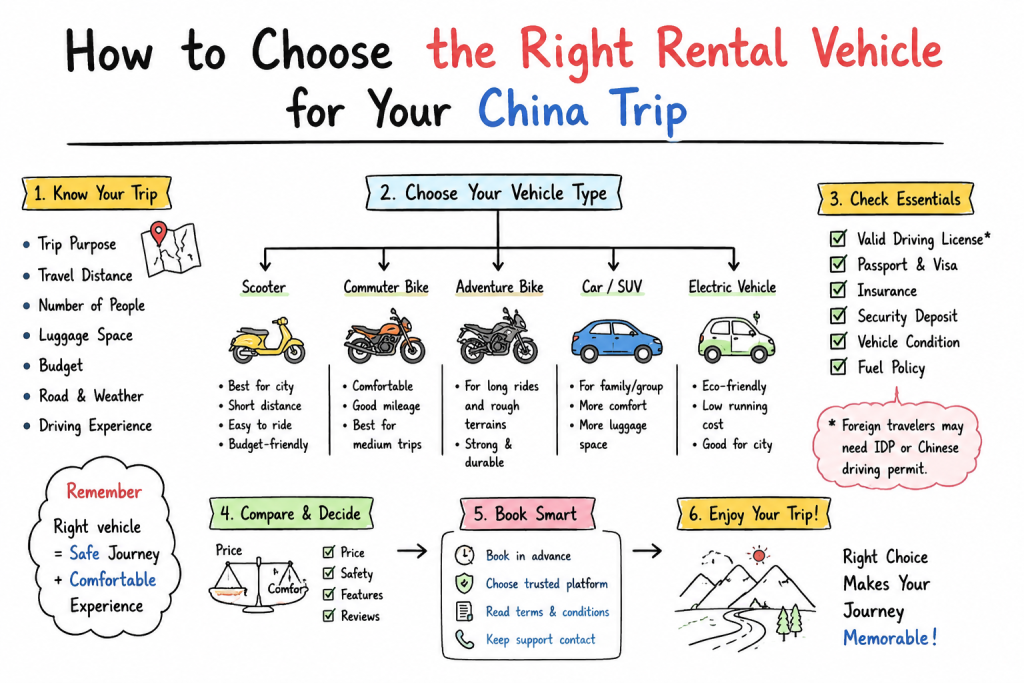
Choosing the right rental vehicle can make the difference between a comfortable, enjoyable journey and a stressful travel experience. A compact scooter may be ideal for short urban trips, while a commuter motorcycle may suit longer daily rides. Families and groups may require a car, whereas adventure travelers may need a vehicle capable of handling hills, long distances, or changing road conditions.
For Indian travelers exploring China, vehicle selection requires additional planning. Road rules, licence requirements, rental procedures, navigation systems, traffic conditions, and vehicle availability may differ from what travelers experience in Delhi, Mumbai, Bangalore, Goa, Jaipur, Pune, Hyderabad, Chennai, or Kolkata.
China also has an extensive public transportation system. Metro networks, buses, taxis, ride-hailing services, bicycles, electric scooters, trains, and rental vehicles can all be useful depending on the city and itinerary. Renting is therefore not automatically the best option for every journey. It becomes valuable when travelers need privacy, flexible timing, access to less-connected areas, or the ability to carry luggage.
This guide explains how to choose the right rental bike, scooter, motorcycle, car, or other self-drive vehicle for your trip. It also covers estimated rental costs, documents, safety checks, common mistakes, and how MotoShare China can simplify the booking process.
Why Renting a Bike or Vehicle Can Be a Smart Choice
Renting a vehicle gives travelers greater control over their schedule. Instead of arranging every journey around a bus, metro, train, or taxi, travelers can decide when to leave, where to stop, and how long to stay at each destination.
A rental vehicle may be particularly useful for:
- Traveling between nearby towns or attractions
- Reaching places with limited public transport
- Taking day trips outside major city centers
- Carrying shopping bags or travel equipment
- Commuting between accommodation and work
- Exploring local neighborhoods at a comfortable pace
- Avoiding repeated taxi bookings
- Following a flexible or changing itinerary
For short local journeys, a bicycle or permitted electric two-wheeler may be easier than a car. For longer distances, a suitable motorcycle or car may offer better comfort and luggage capacity.
Indian travelers who regularly use a bike on rent in India may already understand the convenience of two-wheelers. In cities such as Bangalore and Pune, bikes can help commuters avoid spending unnecessary time waiting for transport. In Goa and Jaipur, rental scooters give tourists greater freedom to explore. Similar decision-making can be useful in China, although local driving permissions and rental conditions must always be checked first.
Who Should Rent a Vehicle?
Vehicle rental can work well for many types of travelers, but the right choice depends on experience, budget, destination, and legal eligibility.
First-Time Travelers
A first-time visitor may benefit from a small, easy-to-operate vehicle for short journeys. However, beginners should avoid renting a powerful motorcycle or driving in unfamiliar high-traffic areas without sufficient experience.
Travelers who are not legally permitted or confident enough to drive should use public transport, taxis, ride-hailing services, or a vehicle with a driver.
Tourists
Tourists staying outside central areas may use rental vehicles for day trips and local sightseeing. A scooter, bicycle, or compact car may provide more independence than a fixed group tour.
Tourists should confirm whether their licence and documents allow them to drive the selected vehicle category in mainland China.
Students
Students may prefer economical bicycles, electric bicycles, scooters where legally available, or small commuter vehicles. Affordability, charging access, campus rules, parking, and rental duration are important considerations.
Working Professionals
Professionals traveling for meetings, temporary assignments, exhibitions, or business projects may need a reliable car or commuter vehicle. Comfort, punctuality, luggage space, invoicing, and flexible rental periods may be more important than selecting the cheapest option.
Backpackers and Budget Travelers
Backpackers usually prioritize low costs, easy parking, fuel efficiency, and basic luggage capacity. A bicycle or small two-wheeler may be suitable for certain local areas, but it may not be appropriate for long intercity routes or poor weather.
Families and Groups
Families and groups should usually consider a car, multi-purpose vehicle, or van. Passenger safety, seatbelts, child-seat availability, luggage capacity, air conditioning, and driver eligibility should guide the decision.
Benefits of Renting a Bike for First-Time Travelers
A bike or scooter can offer several advantages when local regulations allow its use.
Lower Daily Travel Costs
A small two-wheeler may cost less to rent and operate than a car. It can also reduce repeated taxi expenses for travelers making several short journeys during the day.
Easier Parking
Parking a compact two-wheeler is generally easier than parking a large car. This can be useful near markets, smaller streets, university districts, local shopping areas, and tourist neighborhoods.
Better Schedule Flexibility
Travelers can leave early, take breaks, change their route, and return at a convenient time. This freedom is one reason bike rental for tourists is popular in many travel destinations.
Convenient Local Exploration
Travel in India by bike is popular because travelers can explore beyond major roads and crowded transport points. The same principle may apply in suitable Chinese destinations, provided the vehicle is legally permitted and the traveler has the required driving authorization.
More Personal Travel Experience
A two-wheeler allows travelers to observe local streets, neighborhoods, landscapes, and daily life more closely than they might from a train or enclosed tour bus.
Types of Rental Vehicles You Can Choose
Different trips require different vehicles. Selecting the most expensive or powerful model does not necessarily provide the best experience.
Scooters
Scooters are designed for short urban journeys and simple operation. Their step-through design, automatic transmission, light weight, and storage space make them attractive to beginners.
A scooter may be suitable for:
- Short daily commutes
- Local shopping
- Sightseeing within a limited area
- Solo travelers
- Riders carrying light luggage
Before deciding to rent a scooter in China, confirm the vehicle classification, registration, licence requirement, permitted roads, speed restrictions, and local rental rules.
Commuter Bikes
Commuter motorcycles are designed for regular travel and fuel efficiency. They are generally more practical than sports motorcycles for everyday use.
They can suit:
- Medium-distance journeys
- Daily work travel
- Experienced riders
- Travelers who need better road stability
- Routes involving urban and suburban roads
Travelers familiar with an affordable bike rental in India should not assume that identical licence or vehicle rules apply in China.
Sports Bikes
Sports motorcycles offer stronger acceleration and performance, but they require experience and careful control. They may have an aggressive riding position and may not be comfortable for long sightseeing days.
Sports bikes are generally unsuitable for:
- New riders
- Crowded city exploration
- Travelers carrying luggage
- Budget-focused journeys
- Wet or unfamiliar roads
Choose this category only when it is legal, available, insured, and appropriate for your riding experience.
Adventure Bikes
Adventure motorcycles are designed for longer routes, varied terrain, and greater luggage capacity. Their upright riding position can be more comfortable for touring.
They may be suitable for:
- Experienced riders
- Longer touring routes
- Mountain or countryside journeys
- Trips involving luggage
- Routes with varied surfaces
These vehicles can be heavy and tall. Riders should be comfortable controlling them at low speeds and when parking.
Cruiser Motorcycles
Cruisers offer a relaxed seating position and are often chosen for scenic rides. However, their weight and turning characteristics can make them difficult for inexperienced riders in congested areas.
Cruisers may suit confident riders taking relaxed routes with frequent stops.
Electric Bikes and Electric Scooters
Electric mobility is widely used in many Chinese cities. Electric two-wheelers can be quiet, economical, and practical for short-distance travel.
Important factors include:
- Battery range
- Charging access
- Maximum permitted speed
- Local registration rules
- Helmet requirements
- Vehicle classification
- Approved riding lanes
- Restrictions in specific districts or roads
Do not select an electric vehicle based only on its advertised range. Weather, passenger weight, hills, riding speed, battery age, and frequent stops can reduce real-world range.
Compact Cars
A compact car may be the right choice for couples, business travelers, or small families. It offers weather protection, luggage space, and greater comfort than a two-wheeler.
Compact cars are suitable for:
- Airport transfers
- Business trips
- Family sightseeing
- Long travel days
- Winter, rain, or extreme heat
- Travelers carrying several bags
SUVs and Multi-Purpose Vehicles
An SUV or multi-purpose vehicle may be useful for groups, heavy luggage, countryside routes, or longer journeys. However, larger vehicles usually cost more to rent, consume more energy, and are harder to park.
How to Choose the Right Vehicle for Your Trip
Consider the Distance
For trips of only a few kilometers, a bicycle, electric bicycle, scooter, taxi, or metro may be enough. For longer travel days, comfort becomes more important.
A small scooter that feels comfortable during a 20-minute ride may become tiring during a three-hour journey.
Study the Route
Review whether the route includes:
- Busy urban roads
- Expressways
- Mountain roads
- Rural areas
- Tunnels
- Bridges
- Restricted zones
- Unpaved sections
- Limited charging or fuel facilities
Not every vehicle is allowed on every road. Confirm route restrictions before booking.
Count Passengers and Bags
A solo traveler with a backpack has different requirements from a family carrying several suitcases. Never overload a two-wheeler or place luggage where it interferes with steering, braking, lights, or visibility.
Think About Weather
Rain, wind, cold, heat, fog, or snow can make two-wheeler travel uncomfortable or unsafe. A car may be the better choice during poor weather or for travelers unaccustomed to local conditions.
Evaluate Your Driving Experience
Choose a vehicle you can control confidently. Do not treat a holiday as an opportunity to learn how to ride a heavy or high-performance motorcycle on public roads.
Set a Total Budget
The rental rate is only one part of the cost. Consider:
- Fuel or charging
- Insurance
- Security deposit
- Parking
- tolls
- Extra mileage
- Late-return charges
- Cleaning fees
- Delivery and collection
- Additional-driver fees
Check Legal Eligibility
Confirm that you have the correct driving authorization for the vehicle category. A licence that permits car driving may not automatically permit motorcycle riding.
Foreign travelers should verify current mainland Chinese requirements before making a non-refundable booking. An overseas licence or International Driving Permit should not be assumed to be sufficient on its own.
Documents Usually Needed to Rent a Vehicle
Requirements vary by rental company, city, traveler status, and vehicle category.
Valid Driving Licence or Permit
The renter must normally hold a valid licence or permit appropriate for the vehicle. International visitors may need to complete a local provisional permit process before driving in mainland China.
Passport or Government Identification
International tourists may need to present their original passport. Chinese residents may be asked for an accepted national identity document.
Chinese Translation of Foreign Licence
Where required, a foreign driving licence may need an accepted Chinese translation. Ask whether the translation must come from an approved agency or meet specific formatting requirements.
Address or Accommodation Details
Rental providers may request a local address, hotel information, residence registration details, or contact number.
Security Deposit
A refundable deposit may be collected through an accepted payment method. Check:
- Deposit amount
- Refund timeline
- Deduction conditions
- Damage assessment process
- Traffic-fine handling
- Accepted cards or payment platforms
Never leave an original passport as informal security without understanding the legal and practical risks.
Things to Check Before Accepting a Rental Vehicle
Vehicle Condition
Inspect the entire vehicle in good lighting. Take time-stamped photographs or a continuous video of:
- Scratches
- Dents
- Broken panels
- Mirrors
- Wheels and tires
- Windscreen
- Seats
- Lights
- Number plate
- Fuel or battery level
- Dashboard warnings
Ensure all existing damage appears in the handover report.
Tires and Brakes
Check tire pressure, tread condition, visible cracks, brake response, and unusual sounds. Do not accept a vehicle that appears unsafe.
Fuel or Charging Policy
Confirm whether the vehicle must be returned with a full tank, the same fuel level, or a specified battery percentage. Also identify nearby fuel or charging locations.
Insurance Coverage
Ask what the standard policy covers and excludes. Review:
- Third-party liability
- Damage to the rental vehicle
- Theft
- Personal accident protection
- Deductible or excess
- Tire and glass damage
- Unauthorized-road exclusions
- Additional-driver coverage
Mileage Limits
Some rentals include unlimited distance, while others have daily or total mileage limits. Additional kilometers may be charged separately.
Helmet Availability
For two-wheeler rentals, check whether a clean, correctly sized, secure helmet is included. A loose, damaged, or poor-quality helmet should be replaced before departure.
Rental Agreement
Read the agreement before signing. Pay attention to cancellation, late return, breakdown assistance, prohibited areas, cross-city travel, accident reporting, fines, and deposit refunds.
Safety Tips for Riding a Rental Bike
Follow Local Traffic Rules
Observe traffic lights, signs, lane markings, speed restrictions, parking rules, and instructions from authorities. Do not copy unsafe behavior simply because other road users appear to be doing it.
Wear a Proper Helmet
Wear an approved, correctly fitted helmet and fasten the strap. A helmet provides little protection when it is damaged, oversized, or left unfastened.
Avoid Overspeeding
Unfamiliar roads can contain sudden turns, lane changes, pedestrians, cyclists, delivery vehicles, and unexpected surface conditions. Maintain enough distance to stop safely.
Check Weather and Road Conditions
Review the forecast before leaving. Delay the journey when visibility, rain, wind, snow, or road conditions make riding unsafe.
Use Reliable Navigation
Download necessary maps and save the address of your accommodation in Chinese. Mounting a phone safely is better than holding it while riding. Stop in a safe place before changing the route.
Keep Emergency Information Handy
Carry the rental provider’s support number, insurance details, accommodation address, local emergency contacts, and identification.
Avoid Riding While Tired
Fatigue reduces reaction time. Take regular breaks and avoid planning unrealistic daily distances.
Estimated Rental Costs
Rental prices change according to city, season, demand, vehicle age, model, rental duration, insurance, and booking provider. The following figures are broad planning estimates rather than guaranteed MotoShare China prices.
| Vehicle category | Indicative daily range | Typical use |
|---|---|---|
| Bicycle or basic shared cycle | RMB 10–50 | Short local journeys |
| Electric bicycle or low-speed scooter | RMB 40–120 | Urban travel where permitted |
| Commuter motorcycle | RMB 100–250 | Medium-distance riding |
| Premium or sports motorcycle | RMB 300–800+ | Experienced riders |
| Adventure motorcycle | RMB 400–1,000+ | Long-distance or touring routes |
| Compact car | RMB 150–450+ | Couples, families and business trips |
| SUV or multi-purpose vehicle | RMB 350–900+ | Groups, luggage and longer routes |
Availability of motorcycle rentals may be limited in some cities. Certain cities or districts may also impose restrictions on motorcycle registration or road access.
Always request a complete price breakdown. A low advertised rate may exclude insurance, delivery, deposit, mileage charges, helmets, charging, taxes, or service fees.
Common Mistakes First-Time Travelers Should Avoid
Selecting a Vehicle Based Only on Appearance
A stylish motorcycle may be uncomfortable, expensive, or unsuitable for the route. Choose according to practical needs.
Ignoring Licence Requirements
Do not assume that an Indian driving licence or IDP automatically authorizes driving in mainland China.
Booking Before Confirming Documents
Confirm all document requirements before paying a non-refundable amount.
Failing to Record Existing Damage
Photographing the vehicle protects both the renter and the owner during return inspection.
Choosing the Cheapest Insurance
The lowest-cost package may have a high deductible or important exclusions.
Underestimating Travel Time
Traffic, parking, charging, weather, navigation, and rest breaks can extend a journey.
Overloading a Two-Wheeler
Excess luggage reduces balance, braking performance, and rider control.
Crossing City or Provincial Boundaries Without Permission
Some agreements restrict the operating area. Get written approval before planning an intercity trip.
Returning the Vehicle Late
Even a short delay can trigger additional charges. Allow extra time for fuel, charging, traffic, and inspection.
Ignoring Battery Range
Electric vehicles should be returned or recharged according to the agreement. Plan a safe range reserve rather than using the entire advertised capacity.
Rental Bike vs Public Transport vs Taxi
| Factor | Rental bike or scooter | Public transport | Taxi or ride-hailing |
| Cost | Potentially economical for repeated trips | Usually lowest for individual urban journeys | Can become expensive with multiple trips |
| Convenience | High when parking and legal access are available | Depends on station location and operating times | Door-to-door convenience |
| Flexibility | Travelers control route and schedule | Fixed routes and stops | Flexible destination but requires repeated bookings |
| Comfort | Weather exposure and limited luggage space | Can be crowded during peak hours | Better weather protection and seating |
| Travel experience | Personal, independent and immersive | Efficient and practical | Comfortable and direct |
| Navigation effort | Rider must navigate independently | Routes are structured | Driver manages the route |
| Best use cases | Short trips, local exploration and flexible itineraries | Major cities and well-connected attractions | Airport transfers, business travel and poor weather |
| Main limitation | Licensing, safety and weather | Less flexibility in remote areas | Higher cumulative cost |
Public transportation is often the easiest option in large Chinese cities with extensive metro and bus systems. A rental vehicle becomes more useful when the traveler needs greater independence, is legally eligible to drive, and has an itinerary that public transport cannot serve efficiently.
Indian City Examples That Help Explain Vehicle Selection
Travelers can apply lessons from Indian cities when evaluating rental options in China.
Delhi
In Delhi, traffic, heat, air quality, parking, and travel distance influence whether a bike, metro, or car is most practical. Similar factors should be reviewed when traveling through a large Chinese city.
Mumbai
Mumbai travelers often consider rain, congestion, parking, and long suburban distances. During heavy rain, an enclosed vehicle or public transport may be safer than a scooter.
Bangalore
Bangalore demonstrates why small two-wheelers can be convenient for commuting. However, convenience should never replace proper licensing, helmet use, and route planning.
Goa
Goa is associated with scooter-based tourism because attractions are spread across different areas. In China, travelers should look for destinations where local laws, road design, and rental availability support a similar style of exploration.
Jaipur
Jaipur shows how weather, heritage zones, road traffic, and parking affect sightseeing choices. A compact vehicle may be more practical than a large SUV for short urban visits.
Pune and Hyderabad
Both cities illustrate how commuter bikes can support regular work and study travel. Students or professionals staying in China for an extended period may similarly prioritize reliability, energy efficiency, and monthly rental options.
Chennai and Kolkata
Heat, rain, traffic density, road familiarity, and travel distance influence vehicle choice in these cities. Those same practical considerations apply when choosing transportation abroad.
How MotoShare China Can Help Travelers
MotoShare China can simplify vehicle discovery and booking by bringing important rental information into one platform.
Easy Online Booking
Travelers can search for suitable vehicles, review rental periods, compare options, and submit booking details online. This reduces the need to visit multiple rental offices.
Wide Range of Vehicles
Different travelers require different solutions. A vehicle-sharing marketplace may include bicycles, scooters, commuter vehicles, motorcycles, cars, and other mobility options where legally available.
Transparent Pricing
Clear pricing helps travelers understand the rental charge, deposit, mileage terms, insurance, optional equipment, and possible additional fees before confirming.
Verified Vehicle Owners
A structured verification process can improve trust between renters and vehicle owners. Travelers should still inspect the vehicle and review all documents at handover.
Flexible Rental Options
Hourly, daily, weekly, and longer rental periods can help users choose a plan that fits their itinerary rather than paying for unnecessary time.
Availability Across Cities
Travelers can search by location and compare vehicles close to their hotel, workplace, university, transport hub, or intended travel area.
Support for Better Decision-Making
MotoShare China can help users compare vehicle type, seating capacity, transmission, range, luggage space, rental rules, and pricing. The final choice should balance legal eligibility, safety, comfort, route, and budget.
Frequently Asked Questions
1- Can tourists rent a bike or vehicle in China?
Tourists may be able to rent eligible vehicles when they meet the provider’s age, identification, licence, permit, payment, and deposit requirements. Availability depends on the city and vehicle category. Foreign visitors must verify their legal driving eligibility before booking.
2- Is an International Driving Permit enough in mainland China?
An International Driving Permit alone should not be assumed to authorize driving in mainland China. Eligible visitors may need a Chinese provisional driving permit supported by an overseas licence and accepted Chinese translation. Confirm the current process with the appropriate local authority.
3- Can an Indian driving licence be used directly?
An Indian driving licence should not be assumed to be directly valid for driving in mainland China. Indian travelers should check whether they qualify for a provisional or local Chinese permit and whether a Chinese translation is required.
4- How much does vehicle rental cost in China?
A basic bicycle may cost a small daily amount, while electric two-wheelers, motorcycles, cars, and SUVs cost progressively more. City, demand, insurance, mileage, model, deposit, and rental duration all influence the final amount.
5- Are helmets provided with two-wheeler rentals?
Some providers include helmets, while others charge separately. Confirm availability before booking and inspect the helmet for damage, cleanliness, size, fastening, and general condition.
6- Can I rent a vehicle without a deposit?
Certain providers may offer reduced-deposit or deposit-free bookings based on identity verification, payment method, credit arrangements, or insurance. Others require a refundable security amount. Review the refund conditions carefully.
7- What happens when the rental vehicle breaks down?
Move to a safe location and contact the rental provider. Do not authorize major repairs without approval unless an emergency requires immediate action. Keep photographs, receipts, messages, and the breakdown report.
8- Can I take the rental vehicle to another city?
Only when the rental agreement permits intercity travel. Ask about distance limits, restricted areas, provincial travel, one-way return, tolls, roadside assistance, and additional charges.
9- Is a scooter suitable for a long journey?
A small scooter may be convenient for short urban travel but uncomfortable for long routes, high-speed roads, mountain terrain, or heavy luggage. A suitable car or touring vehicle may be safer and more comfortable.
10- Should I choose a bike or a car?
Choose a bike for short solo travel, easier parking, and lower operating costs where legally permitted. Select a car for families, luggage, long distances, difficult weather, business travel, or greater comfort.
11- What should I photograph during vehicle pickup?
Photograph every side of the vehicle, wheels, tires, mirrors, glass, seat, dashboard, fuel or battery level, registration plate, and existing damage. Ensure the date and time can be verified.
12- Is insurance included in the rental price?
Basic coverage may be included, but the scope varies. Ask about third-party liability, collision damage, theft, personal accident protection, deductible, exclusions, and unauthorized-road restrictions.
13- Can first-time riders rent a motorcycle?
A legally licensed but inexperienced rider should still avoid powerful motorcycles and difficult routes. A rental trip is not the right environment for learning basic vehicle control. Training and supervised practice should come first.
14- Are electric scooters suitable for tourists?
They may be suitable for short local travel when permitted, but tourists must understand vehicle classification, registration, riding lanes, charging, battery range, parking, helmet rules, and local restrictions.
15- What is the most important factor when choosing a rental vehicle?
Safety and legal eligibility come first. The vehicle should then match the route, distance, weather, number of passengers, luggage, experience level, comfort needs, and complete travel budget.
Conclusion
The right rental vehicle is not always the cheapest, fastest, or most powerful option. It is the vehicle that fits your route, passenger count, luggage, riding or driving experience, legal eligibility, weather conditions, comfort expectations, and budget.
A bicycle or electric two-wheeler may be suitable for short local trips. A commuter motorcycle may work for an experienced and properly licensed rider. A compact car can provide greater comfort for couples and families, while an SUV or multi-purpose vehicle may be more appropriate for groups and heavy luggage.
Indian travelers should remember that experience with bike rental in India does not automatically prepare them for different driving rules and licensing procedures in China. Check the latest requirements, understand the rental contract, inspect the vehicle, select appropriate insurance, and avoid driving when conditions feel unfamiliar or unsafe.
