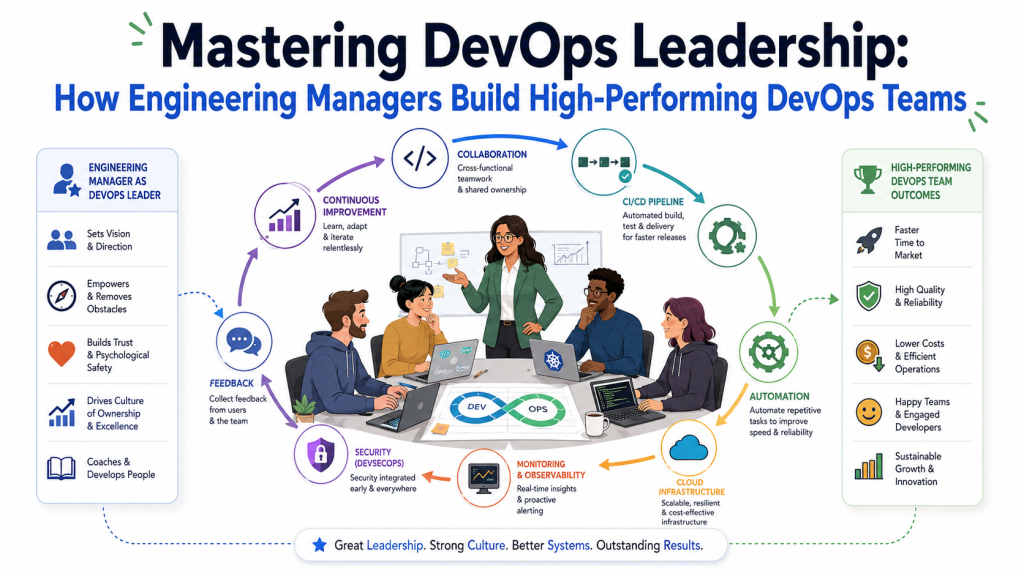
Introduction
Technology leaders face increasing pressure to deliver software faster while maintaining quality, security, and reliability. As organizations grow, engineering managers and CTOs must coordinate multiple development teams, cloud platforms, security requirements, and production environments. Success depends not only on technical tools but also on leadership, communication, governance, and continuous improvement.
This guide explores DevOps from a leadership perspective. Rather than focusing on command-line tools or individual technologies, it explains how engineering leaders can create high-performing DevOps teams, establish engineering standards, measure success, and build a culture of innovation.
Why DevOps Leadership Matters
Many organizations invest in automation tools but overlook the leadership needed to make transformation successful.
Effective DevOps leaders:
- Align engineering with business objectives
- Remove organizational silos
- Promote automation
- Encourage continuous learning
- Standardize engineering practices
- Support innovation without compromising stability
Leadership transforms DevOps from a technical initiative into a business capability.
Building the Right DevOps Culture
High-performing teams share common characteristics:
- Shared ownership
- Transparent communication
- Continuous feedback
- Experimentation
- Blameless incident reviews
- Cross-functional collaboration
Creating this culture requires consistent leadership rather than one-time initiatives.
Defining Engineering Standards
Successful organizations create standardized approaches for:
- Source control
- Branching strategies
- Code reviews
- CI/CD pipelines
- Infrastructure as Code
- Kubernetes deployments
- Security validation
- Monitoring
- Documentation
Engineering standards improve consistency and reduce operational complexity.
Creating High-Performance Teams
Engineering managers should balance technical expertise with collaboration.
A modern DevOps organization may include:
- Software Developers
- DevOps Engineers
- Platform Engineers
- Site Reliability Engineers
- Security Engineers
- Cloud Architects
- QA Automation Engineers
Clearly defined responsibilities improve delivery efficiency while encouraging collaboration.
Developing a DevOps Maturity Model
Organizations progress through multiple stages of maturity:
Level 1 – Manual Operations
Manual deployments, inconsistent environments, limited automation.
Level 2 – Basic Automation
Version control, CI pipelines, repeatable builds.
Level 3 – Cloud-Native Adoption
Containers, Kubernetes, Infrastructure as Code, cloud platforms.
Level 4 – Enterprise DevOps
DevSecOps, GitOps, observability, SRE practices.
Level 5 – Engineering Excellence
Platform Engineering, self-service infrastructure, AI-assisted operations, continuous optimization.
Understanding maturity helps leaders prioritize investments and measure progress.
Managing Cloud-Native Transformation
Cloud adoption requires more than moving applications to virtual machines.
Leaders should focus on:
- Cloud governance
- Cost management
- Security policies
- Resource optimization
- Disaster recovery
- Compliance
- Automation
A strategic approach ensures sustainable cloud growth.
Strengthening DevSecOps
Security becomes everyone’s responsibility.
Leadership should encourage:
- Security-first design
- Automated vulnerability scanning
- Secure coding standards
- Compliance automation
- Regular security training
Integrating security into development pipelines reduces risk while supporting rapid delivery.
Introducing Platform Engineering
Platform Engineering simplifies software delivery by providing reusable internal platforms.
Benefits include:
- Standardized deployment pipelines
- Self-service infrastructure
- Shared monitoring
- Built-in security
- Developer portals
Engineering leaders should evaluate when Platform Engineering becomes appropriate based on organizational size and complexity.
Measuring Engineering Success
Meaningful metrics help leaders evaluate progress.
Useful indicators include:
| Metric | Why It Matters |
|---|---|
| Deployment Frequency | Measures delivery speed |
| Lead Time | Indicates development efficiency |
| Change Failure Rate | Reflects release quality |
| Mean Time to Recovery | Measures operational resilience |
| Customer Satisfaction | Connects engineering to business outcomes |
Leaders should avoid vanity metrics and focus on measurements that support continuous improvement.
Coaching and Mentoring Teams
Strong technical teams require ongoing development.
Managers should invest in:
- Technical workshops
- Pair programming
- Knowledge-sharing sessions
- Internal documentation
- Hands-on labs
- Professional certifications
Continuous learning improves both individual performance and organizational capability.
Common Leadership Challenges
Engineering leaders often face:
- Resistance to change
- Legacy systems
- Budget constraints
- Skill shortages
- Cloud migration complexity
- Security concerns
- Scaling engineering teams
Addressing these challenges requires patience, communication, and incremental improvement.
Choosing the Right DevOps Partner
Organizations seeking external support should evaluate:
- Enterprise implementation experience
- Corporate training capability
- Cloud expertise
- Kubernetes knowledge
- DevSecOps experience
- Platform Engineering skills
- Long-term mentoring approach
A strong consulting partner complements internal leadership rather than replacing it.
Future Trends for Engineering Leaders
Modern engineering organizations are increasingly adopting:
- AI-assisted software delivery
- Platform Engineering
- Internal Developer Platforms
- GitOps workflows
- Intelligent observability
- FinOps
- Sustainable cloud operations
Leaders who prepare for these trends will be better positioned to support long-term business growth.
Decision Guide
This guide is suitable for:
- CTOs planning cloud modernization
- Engineering Managers leading DevOps adoption
- Organizations scaling Kubernetes environments
- Businesses building internal developer platforms
- Companies investing in DevOps Corporate Training
- Enterprises seeking experienced DevOps Consultants
Frequently Asked Questions
1. Why is leadership important in DevOps?
Leadership aligns technical initiatives with business goals, promotes collaboration, and supports continuous improvement.
2. What skills should a DevOps leader have?
Technical understanding, communication, mentoring, strategic planning, cloud knowledge, automation expertise, and change management.
3. How do engineering managers measure DevOps success?
Using metrics such as deployment frequency, lead time, change failure rate, recovery time, and customer satisfaction.
4. What is the role of Platform Engineering?
Platform Engineering creates standardized internal platforms that simplify software delivery and improve developer productivity.
5. When should organizations invest in DevOps Corporate Training?
When expanding engineering teams, adopting cloud-native technologies, or introducing new operational practices.
6. How does DevSecOps support business objectives?
It integrates security into development workflows, reducing vulnerabilities while maintaining delivery speed.
7. Why is Kubernetes governance important?
Governance ensures clusters remain secure, scalable, and manageable as organizations grow.
8. How can leaders encourage continuous learning?
By providing structured training, mentoring, certifications, and opportunities for practical experience.
9. What are the biggest obstacles to DevOps transformation?
Cultural resistance, inconsistent processes, legacy systems, limited automation, and insufficient training.
10. How can organizations sustain long-term DevOps success?
By combining technical excellence with strong leadership, measurable goals, continuous learning, and a culture of collaboration.
Conclusion
Building a successful DevOps organization requires more than selecting the right technologies. Engineering leaders must establish clear standards, foster collaboration, encourage continuous learning, and align technical decisions with business priorities. By investing in people, processes, and automation, organizations can create resilient engineering teams capable of delivering secure, reliable, and innovative software at scale.
