Introduction
Software delivery is now faster than ever. Teams build on cloud, deploy through CI/CD, use containers, manage infrastructure through code, and release changes in short cycles. This speed is good for business, but it also creates pressure. A single weak permission, exposed secret, risky dependency, or insecure pipeline step can turn into a serious problem.
This is why DevSecOps has become such an important part of modern engineering. It brings security into the same flow as development, testing, deployment, and operations. Instead of checking security only at the end, teams build it into everyday work. That makes delivery safer, cleaner, and more mature.
For software engineers, this means learning how to build and release with security in mind. For managers, it means understanding how to guide teams that must balance speed, quality, and risk. For both groups, a focused certification can make this journey clearer.
The DevSecOps Certified Professional, also called DSOCP, is designed for this purpose. It helps working professionals understand how secure software delivery should work in real engineering environments. This guide explains what the certification is, why it matters, who should take it, how to prepare for it, and how it fits into long-term career growth.
What is DevSecOps Certified Professional (DSOCP)
DevSecOps Certified Professional is a professional certification built for people who want stronger skills in secure software delivery. It is designed around the idea that security should not be treated as a separate final step. Instead, it should be part of the full software lifecycle.
In simple terms, DSOCP helps professionals understand how security fits into development, CI/CD, cloud usage, automation, release flow, infrastructure, and operations. It connects technical delivery with security thinking in one structured learning path.
This certification is useful because many professionals already know parts of the system. A DevOps engineer may know automation and pipelines. A software engineer may know coding and testing. A security engineer may know controls and risk. But modern delivery needs these areas to work together. DSOCP helps build that combined understanding.
Why it Matters in Today’s Software, Cloud, and Automation Ecosystem
Modern software systems are complex. Applications are no longer simple monoliths running on a single server. Teams use containers, Kubernetes, APIs, cloud services, shared platforms, third-party libraries, and automated delivery systems. Each of these brings value, but each also brings risk.
A fast pipeline can push vulnerable code into production. A cloud misconfiguration can create open access. A poor secret-handling process can expose credentials. A weak dependency review can introduce security issues without anyone noticing. These are not rare situations anymore. They are normal risks in modern delivery environments.
That is why DevSecOps matters so much. It teaches teams to think about security during planning, coding, testing, building, releasing, and operating. This reduces the gap between speed and safety.
For engineers, DevSecOps creates better habits. It improves how they think about code, automation, permissions, release flow, and operational safety. For managers, it gives a clearer model for team maturity. Instead of asking only whether software ships fast, they start asking whether it ships safely and responsibly.
In today’s ecosystem, security is part of software quality. A team that moves quickly but creates hidden risk is not truly mature. DevSecOps helps solve that problem by making secure delivery part of normal engineering behavior.
Why Certifications are Important for Engineers and Managers
Many professionals learn from work experience, and that is essential. Real projects teach pressure, ownership, trade-offs, and collaboration. But practical learning can become uneven. One engineer may know pipelines well but not secure delivery. Another may understand cloud services but not release governance. A manager may know delivery goals but not how to assess DevSecOps maturity.
Certifications help bring order to this situation.
For engineers, certification creates a roadmap. It shows what to learn, how topics connect, and where gaps exist. It reduces random learning and makes professional growth more focused. It also helps during interviews, promotions, consulting assignments, and internal role changes.
For managers, certification is useful because it creates a common skill framework. It becomes easier to define expectations, support team learning, and align technical capability with business goals. A manager who understands certification paths can guide engineers more effectively.
Certifications also help people stay current. Software delivery practices change quickly. Cloud models change. Security expectations change. A structured certification helps professionals refresh and strengthen their knowledge in a more disciplined way.
A certification does not replace project experience, but when combined with hands-on work, it becomes a strong career asset.
Why Choose DevOpsSchool?
DevOpsSchool is a good choice for professionals who want practical learning aligned with modern engineering roles. One major strength is that it supports a wider ecosystem of learning areas such as DevOps, DevSecOps, SRE, AIOps, DataOps, and FinOps. This matters because real careers often move across these domains.
A professional may start with DevOps, then move into DevSecOps, and later grow into SRE, platform engineering, or cloud governance. A provider that supports connected learning paths is more useful than one that covers only one narrow topic.
DevOpsSchool is also relevant for working professionals because its certification direction is close to practical engineering work. Learners do not only need theory. They need knowledge that connects with CI/CD pipelines, cloud systems, automation models, deployment processes, and team responsibilities.
Another benefit is continuity. After DSOCP, learners may want to continue into broader or deeper areas. DevOpsSchool’s wider certification ecosystem makes that path easier to plan.
For engineers and managers who want structured, relevant, and career-aligned learning, DevOpsSchool is a strong option.
Certification Deep-Dive: DevSecOps Certified Professional (DSOCP)
What is this certification?
DSOCP is a professional certification that helps people understand secure delivery in real software environments. It focuses on how security should be integrated into development, automation, testing, deployment, cloud workflows, and operations.
It is not only about security tools. It is about building a secure engineering mindset across the delivery lifecycle.
Who should take this certification?
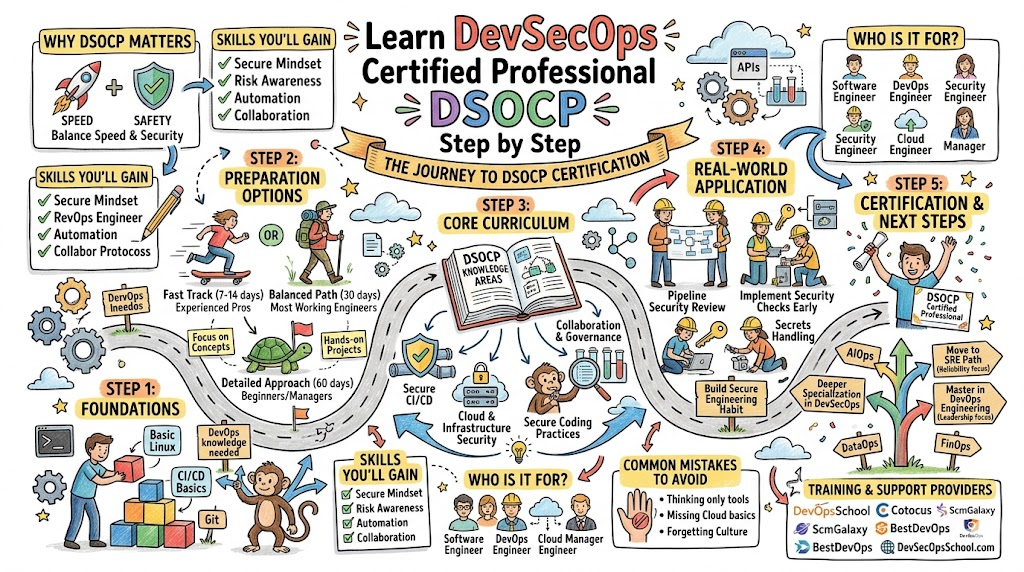
This certification is a good fit for:
- Software Engineers
- DevOps Engineers
- Cloud Engineers
- Platform Engineers
- Security Engineers
- Build and Release Engineers
- Reliability-focused professionals
- Technical Leads
- Engineering Managers
It is especially useful for people who already work near software delivery and want stronger security understanding without moving away from engineering reality.
Certification Overview Table
| Certification Name | Track | Level | Who it’s for | Prerequisites | Skills covered | Recommended order |
|---|---|---|---|---|---|---|
| DevSecOps Certified Professional (DSOCP) | DevSecOps | Professional | Software engineers, DevOps engineers, cloud engineers, platform engineers, security engineers, managers | Basic Linux, scripting, CI/CD, cloud, and DevOps knowledge is helpful | Secure delivery, DevSecOps principles, CI/CD security thinking, risk-aware automation, secure engineering mindset | Main certification in the DevSecOps path |
| DevOps Certified Professional (DCP) | DevOps | Professional | Professionals building automation and delivery pipelines | Basic Linux, Git, scripting, CI/CD basics | DevOps workflow, automation, deployment maturity, pipeline understanding | Before or alongside DSOCP |
| Master in DevOps Engineering (MDE) | DevOps / Leadership | Advanced | Engineers and managers looking for broader technical growth | Practical DevOps and delivery experience | Advanced automation, architecture thinking, platform maturity, leadership readiness | After DSOCP for broader growth |
DevSecOps Certified Professional (DSOCP)
What it is
DSOCP is a career-focused certification for professionals who want to improve how software is delivered with security in mind. It helps turn security into a built-in engineering habit instead of a late-stage review activity.
Who should take it
It is ideal for people already working with software development, automation, cloud platforms, delivery pipelines, infrastructure, or operations who now want stronger security alignment in their role. It is also useful for managers who want better insight into secure delivery maturity.
Skills you’ll gain
- Strong understanding of DevSecOps fundamentals
- Clearer view of security across the delivery lifecycle
- Better awareness of secure CI/CD concepts
- Improved understanding of risk in cloud and automation workflows
- Better collaboration thinking across development, operations, and security
- Awareness of governance and control in engineering systems
- More mature release and delivery thinking
- Stronger secure engineering mindset
Real-world projects you should be able to do after it
- Review a CI/CD pipeline and identify security weaknesses
- Design a safer delivery model for an application team
- Improve release workflows with stronger control points
- Support better secrets handling and access practices
- Help move security checks earlier into development and deployment flow
- Create a simple DevSecOps adoption plan for a growing team
- Support secure cloud deployment practices
- Improve coordination between engineering and security teams
Preparation plan
7–14 days
This plan is best for experienced professionals who already know DevOps, cloud basics, and delivery workflows. Focus on key DevSecOps concepts, secure delivery thinking, common risk areas, and practical scenario review.
30 days
This is the best plan for most working engineers. Start with DevOps basics, then move into security foundations, secure delivery flow, cloud-related risks, and practical use cases. Keep the last stage for revision and self-checking.
60 days
This plan is better for beginners, managers from less technical backgrounds, or professionals changing tracks. Begin with Linux, Git, scripting, CI/CD, and cloud basics. Then move into DevSecOps concepts, pipeline risks, and secure delivery scenarios step by step.
Common mistakes
- Trying to learn DevSecOps without basic DevOps knowledge
- Treating DevSecOps as only a security tooling topic
- Ignoring cloud and container basics
- Learning theory without connecting it to delivery pipelines
- Thinking security belongs only to the security team
- Studying only for the exam and not for real-world use
- Missing the importance of team culture and collaboration
Best next certification after this
The next move depends on your long-term goal.
If you want deeper specialization, continue in the DevSecOps direction.
If you want stronger operational reliability and resilience, move into the SRE path.
If you want wider architecture, platform, and leadership growth, move toward Master in DevOps Engineering.
Choose your path
DevOps
Choose this path if your main focus is automation, CI/CD, deployment quality, and release speed. DSOCP adds security depth to this path and helps build more mature delivery capability.
DevSecOps
Choose this path if secure software delivery is where you want to specialize. DSOCP is a strong anchor certification because it gives the practical base required for deeper growth in this area.
SRE
Choose this path if your focus is reliability, observability, production stability, and service quality. DevSecOps knowledge strengthens SRE because secure systems are easier to run safely and consistently.
AIOps/MLOps
Choose this path if you want to work with intelligent operations, machine learning-driven automation, and predictive systems. DSOCP gives strong engineering discipline before moving into more advanced automation models.
DataOps
Choose this path if your work involves data pipelines, analytics platforms, governance, and controlled delivery. Data environments also need secure workflows and disciplined automation, so DSOCP is useful here too.
FinOps
Choose this path if your role includes cloud cost control, governance, budgeting, and accountability. Secure delivery and cost-aware delivery often grow together because both depend on disciplined engineering practices.
Role → Recommended Certifications
| Role | Recommended certifications |
|---|---|
| DevOps Engineer | DCP → DSOCP → MDE |
| SRE | DCP or DSOCP → SRE-focused path → MDE |
| Platform Engineer | DCP → DSOCP → MDE |
| Cloud Engineer | DCP → DSOCP → MDE |
| Security Engineer | DSOCP → deeper DevSecOps specialization |
| Data Engineer | DCP or DSOCP → DataOps path |
| FinOps Practitioner | DevOps basics → DSOCP → FinOps path |
| Engineering Manager | DSOCP → MDE → broader leadership growth |
Next certifications to take
Same track
Stay within the DevSecOps track if you want more depth in secure delivery, engineering controls, secure architecture, and security-aware release practices. This is the best direction for professionals who want security to become a central part of their technical identity.
Cross-track
Move into an SRE-focused path if you want to combine secure delivery with reliability, resilience, observability, and service operations. This is a strong choice for professionals who enjoy production-focused engineering.
Leadership
Move toward Master in DevOps Engineering if your goal is broader platform understanding, architecture visibility, engineering maturity, and leadership readiness. This is a natural path for senior engineers and technical managers.
Training and Certification Support Providers
DevOpsSchool
DevOpsSchool is the official provider connected to the DSOCP certification page. It is a strong option for professionals who want structured, practical, and role-aligned learning in DevSecOps and related areas. Its broader ecosystem also supports continued growth after one certification.
Cotocus
Cotocus is known for training and consulting support across technical and engineering domains. It can help professionals and teams looking for applied learning, practical guidance, and structured capability development linked to real delivery work.
ScmGalaxy
ScmGalaxy is associated with technical training, workshops, and certification-oriented learning. It is useful for learners who want broader DevOps exposure, hands-on understanding, and support in automation and delivery-related topics.
BestDevOps
BestDevOps is another known name in the training and certification support space. It is useful for professionals seeking practical learning, project-based guidance, and technical growth support in modern engineering environments.
devsecopsschool.com
DevSecOpsSchool is a specialized platform focused on secure software delivery and DevSecOps learning. It is useful for professionals who want deeper specialization in security-aware engineering and longer-term growth after or alongside DSOCP.
SRESchool
SRESchool is a specialized learning platform focused on Site Reliability Engineering skills. It is useful for professionals who want to build knowledge in reliability, monitoring, incident response, automation, SLIs, SLOs, and production operations. For learners coming from a DevSecOps background, SRESchool can be a strong next step because it helps connect secure delivery with stable and dependable production systems.
AIOpsSchool
AIOpsSchool is designed for professionals who want to understand how artificial intelligence and machine learning can improve IT operations. It supports learners who are interested in intelligent monitoring, event correlation, anomaly detection, predictive operations, and automated incident handling. For engineers who already know DevOps or DevSecOps, this platform can help expand into modern AI-driven operations.
DataOpsSchool
DataOpsSchool is aimed at learners who want to improve data pipeline delivery, governance, quality, and collaboration across data teams. It is helpful for data engineers, analytics teams, and platform professionals who want to bring automation, security, and reliability into data workflows. For someone pursuing DSOCP, DataOpsSchool can add value when working in data-heavy cloud environments where secure and controlled delivery matters.
FinOpsSchool
FinOpsSchool focuses on cloud financial operations and helps professionals understand cost optimization, cloud usage visibility, budgeting, governance, and cost accountability. It is especially useful for cloud engineers, platform teams, and managers who want to connect technical decisions with financial impact. For learners with DevSecOps knowledge, FinOpsSchool adds a strong business perspective to engineering and operations work.
FAQs
1. Is DSOCP difficult for beginners?
It can be challenging if you are new to DevOps, cloud, and automation. But with a proper study plan and steady learning, it becomes manageable.
2. How much preparation time is usually needed?
Most working professionals can prepare in about 2 to 8 weeks depending on their background and available study time.
3. Do I need DevOps knowledge before starting?
Yes, basic DevOps understanding is strongly helpful. DevSecOps becomes easier when you already know software delivery flow and automation basics.
4. Is DSOCP only for security professionals?
No. It is useful for software engineers, DevOps engineers, cloud engineers, platform engineers, and managers too.
5. Can managers benefit from DSOCP?
Yes. Managers gain a better understanding of secure delivery maturity, team capability, and engineering risk.
6. Does DSOCP help in interviews?
Yes. It helps you explain secure delivery, DevSecOps thinking, and risk-aware engineering in a clearer and more structured way.
7. Is DSOCP useful for software engineers?
Yes. Modern software engineers need to understand how security fits into coding, testing, releasing, and deployment.
8. Does this certification support career growth?
Yes. It strengthens your profile for roles that require secure delivery capability and broader engineering maturity.
9. What roles benefit most from DSOCP?
DevOps Engineer, DevSecOps Engineer, Cloud Engineer, Platform Engineer, Security Engineer, and Engineering Manager roles all gain strong value from it.
10. Is DSOCP practical or theory-focused?
It becomes most valuable when connected to real delivery pipelines, engineering decisions, and actual project workflows.
11. What should I study after DSOCP?
That depends on your goal. Go deeper into DevSecOps, move into SRE, or expand toward broader DevOps leadership and architecture.
12. Is DSOCP relevant outside India?
Yes. Secure software delivery is a global need, so the certification is useful across markets and industries.
FAQs on DevSecOps Certified Professional (DSOCP)
1. What does DSOCP stand for?
DSOCP stands for DevSecOps Certified Professional.
2. Who should seriously consider this certification?
Professionals working with software delivery, CI/CD, cloud platforms, automation, or engineering operations should strongly consider it.
3. What is the main purpose of DSOCP?
Its main purpose is to help professionals understand how security should be built into modern software delivery.
4. Is DSOCP a good choice for cloud engineers?
Yes. Cloud engineers benefit because secure automation and safe delivery are essential in cloud environments.
5. Can DSOCP help me move from DevOps to DevSecOps?
Yes. It is a practical bridge for professionals who want to add stronger security depth to DevOps knowledge.
6. Is DSOCP useful for technical managers?
Yes. It helps managers understand delivery maturity, secure engineering practices, and team guidance.
7. Will DSOCP support long-term career credibility?
Yes. It shows focused learning in a valuable area of modern engineering and strengthens professional direction.
8. Why is DSOCP worth considering now?
Because modern software teams must balance speed and security, and DSOCP helps professionals build that balance.
Conclusion
DevSecOps Certified Professional is a strong certification for engineers and managers who want to make software delivery safer, more mature, and more aligned with today’s engineering reality. Modern delivery systems are fast, automated, cloud-driven, and full of moving parts. That makes secure thinking more important than ever. DSOCP helps professionals understand how security should work inside development, CI/CD, cloud usage, and operations instead of outside them. For software engineers, it improves role readiness. For managers, it improves team guidance. For both, it creates a stronger path toward long-term relevance in modern engineering careers.